
In short
- Rule 1: every colored honey patch gets exactly one bear.
- Rule 2: no two bears share a comb lane, in any of the three directions.
- Gaps end lanes. Bears on either side of a missing tile don't conflict.
- Claw first, bear last. Rule tiles out with free claw marks; place a bear only when it's forced.
01The two rules
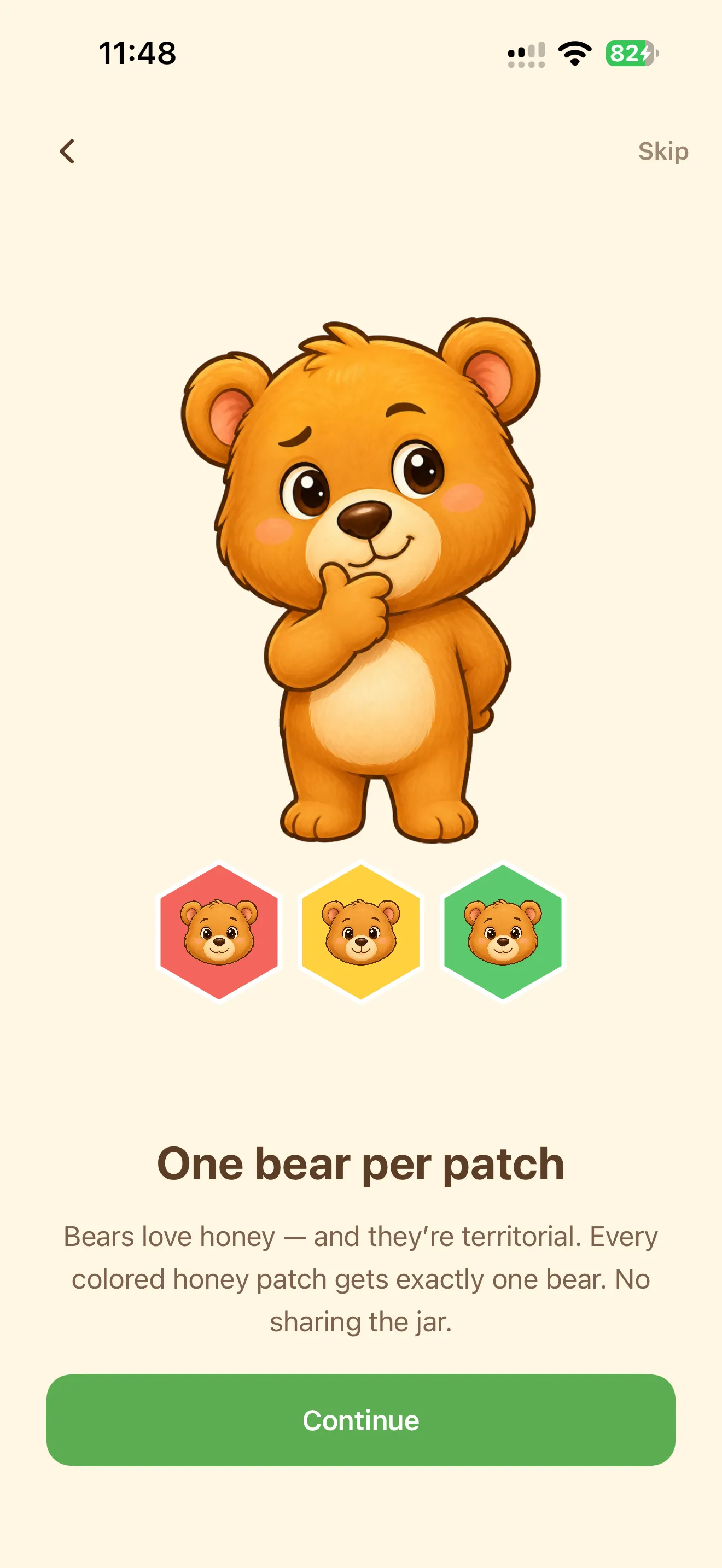
A honeycomb sudoku board is a cluster of hexagonal tiles divided into colored regions. In CombDoku those regions are called honey patches, and the pieces you place are bears. The bears are territorial, which gives you the two rules:
- One per patchEvery honey patch gets exactly one bear. Ten patches, ten bears.
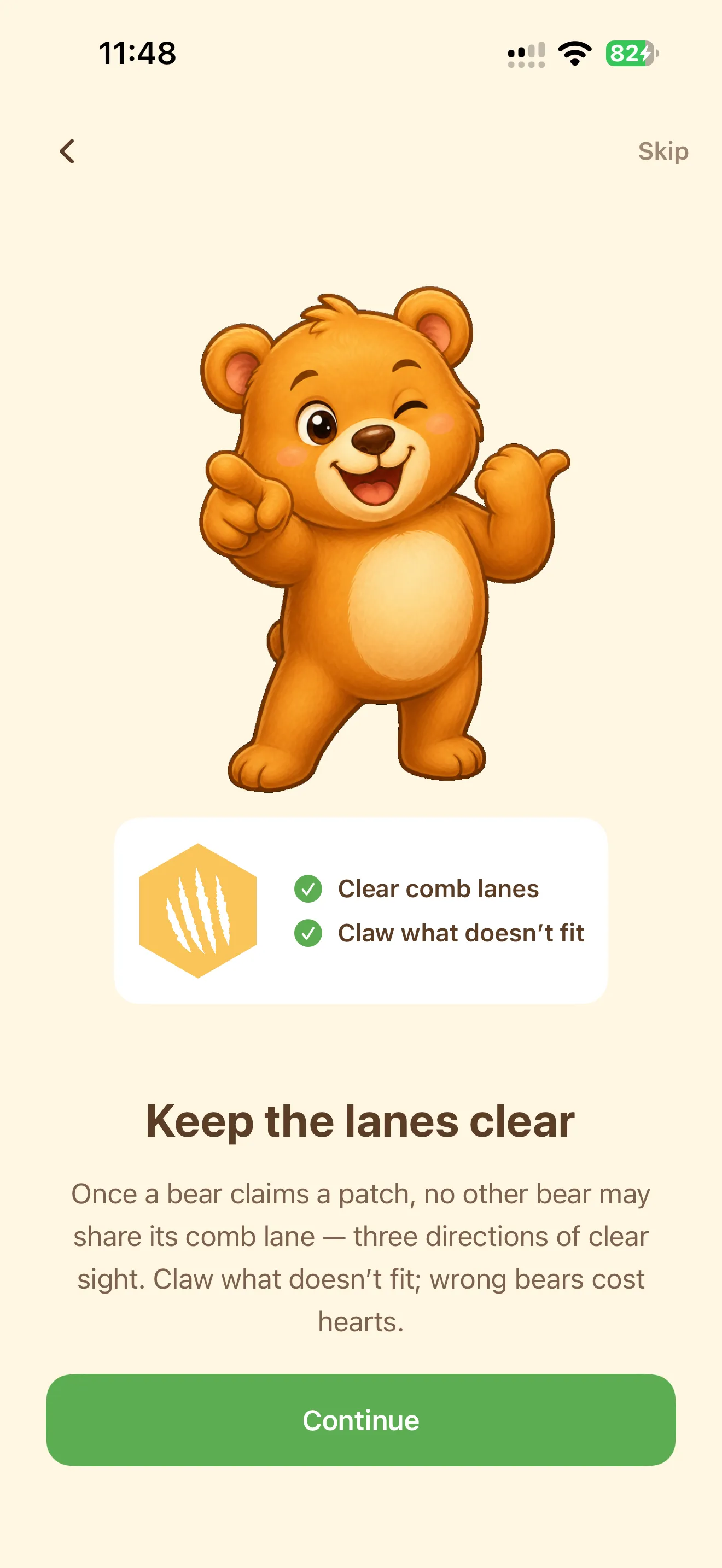
- One per laneNo two bears may sit on the same comb lane. Lanes run in three directions across the hex grid.
That's the whole rulebook. If you've played Queens or Star Battle you'll recognize the idea of one piece per region, but square-grid puzzles also need a "no touching" rule. On a hex grid it's redundant: every tile's six neighbors already share one of its three lanes, so two bears can never touch anyway.
02Comb lanes and gaps
A comb lane is a straight run of hexes in one of the three directions: across, and the two diagonals. Every tile sits on exactly three lanes, one in each direction. When you place a bear, it claims all three.
Here's the nuance most new players miss: lanes are unbroken runs, not infinite lines. CombDoku boards are irregular honeycomb shapes, and some have gaps where a tile is missing. A gap ends the lane. Two bears on opposite sides of a gap, in the same direction, don't conflict.
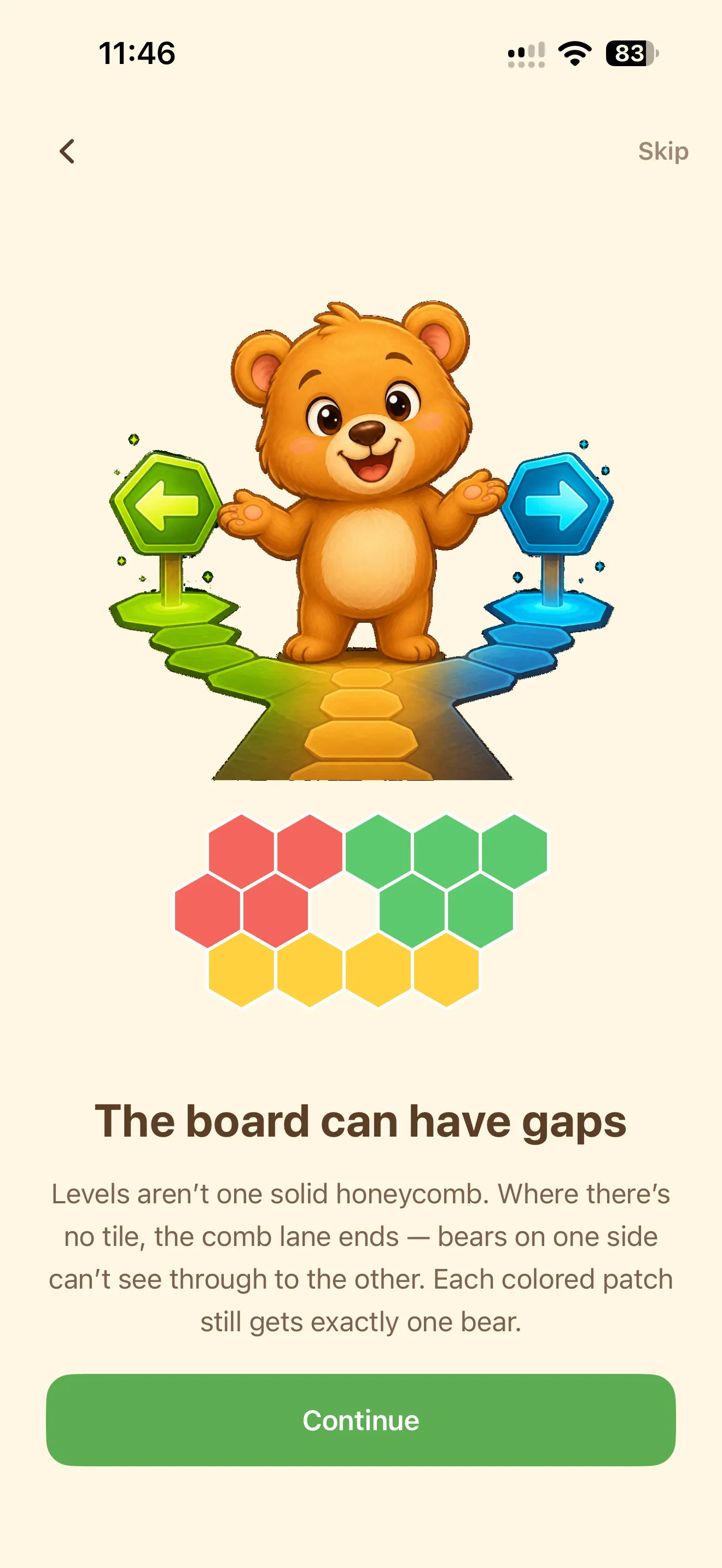
See a tile's lanes: in CombDoku, press and hold any tile. The app dims everything except that tile's three comb lanes, stopping at gaps. It's free, and it's the quickest way to train your eye.
03Claws, bears and hearts
- Single tapPlaces a claw mark, your own "not here" note. Claws are never checked and never cost anything. Drag across tiles to claw several at once.
- Double tapPlaces a bear. Tap a claw or a bear again to remove it.
- Press and holdHighlights the tile's three comb lanes.
Each attempt starts with three hearts (shown as honey jars). Every bear is checked against the board's single solution, so a bear on the wrong tile costs a heart even if it doesn't break a visible rule yet. The bear doesn't stay, and a red claw marks the tile so you don't try it again. Out of hearts, you can revive once per attempt by watching an optional ad (the board stays exactly as it was) or retry from the start.
04Four solving techniques
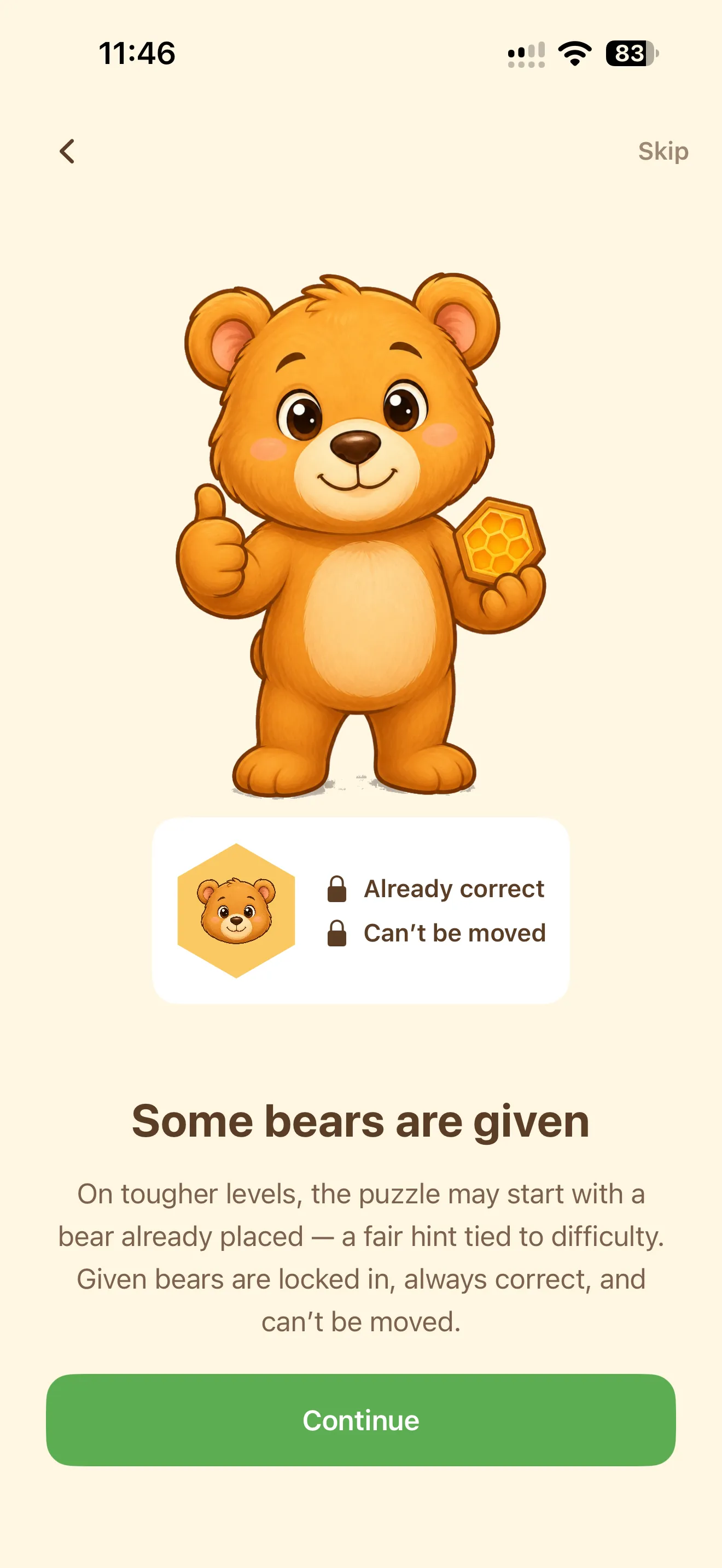
Every CombDoku board is checked when it's made: it must have exactly one solution, and it must be solvable with only the four techniques below (plus the given bear, on levels that start with one). Learn these four and you never need to guess. They're also the steps CombDoku's Hint explains, one at a time, on your current board.
1. Lane conflict
The basic elimination. Once a bear is placed, every other tile in its patch is out, and so is every tile on its three comb lanes, up to the nearest gap. Claw them all.
Example: you place a bear in the small blue patch near the top. Its across-lane runs through the yellow and green patches, and its two diagonals cross the orange patch. Claw every one of those tiles; they can't hold a bear. Doing this immediately after every bear keeps the board readable.
2. Last open spot
If a patch has only one tile left that isn't clawed and isn't on a lane already claimed by a bear, the bear goes there. This is the move that actually places bears.
Example: the purple patch has four tiles. Two are on the lane of the blue bear you just placed, and one is on the green bear's diagonal. Only one tile is left, so that's purple's bear. The smallest case is a one-tile patch: its bear is placed for free, so always start there.
3. Patch locks a lane
If every remaining tile of a patch lies on the same comb lane, you don't yet know which tile gets the bear, but you know that lane is taken. Claw the tiles on that lane that belong to other patches.
Example: the red patch is down to three candidates, all on one diagonal. Wherever red's bear lands, it sits on that diagonal, so the two orange tiles and one green tile further along the same diagonal are out. This often creates a new "last open spot" somewhere else.
4. Locked pair
The same idea for two patches at once. If two patches are each confined to the same two lanes in one direction, those two lanes belong to those two patches between them. Claw the tiles on those lanes in every other patch.
Example: the yellow and pink patches each have candidates only on lanes 3 and 4 of the across direction. One of them takes lane 3, the other lane 4. Either way, nobody else can use those lanes, so claw the teal tiles sitting on them.
How hard is a board? The biggest factor isn't technique depth but how even the patches are. Boards with similar-sized patches have no free one-tile starts, so you have to chain more eliminations before the first bear is forced. Most later CombDoku boards have 10 bears.
05A solving routine
- Scan for tiny patches. One-tile patches are free bears. Two-tile patches are nearly as good.
- Place forced bears, then clear their lanes. After every bear, claw its patch and its three lanes (technique 1).
- Check each patch for a last open spot (technique 2).
- Look for patches confined to one lane and clear that lane elsewhere (technique 3).
- Look for pairs of patches sharing two lanes (technique 4).
- Repeat. Each new claw can unlock a new last open spot.
If you get stuck, CombDoku's Hint finds the next deduction from your current board, names the technique, and previews the move before you apply it. A Reveal places a high-impact bear and claws every tile it rules out. You start with three of each.
06Tips for harder boards
- Claw first, bear last. Wrong bears cost hearts; claws are free. Only double-tap when a tile is forced.
- Hold to check lanes. Before committing, press and hold the tile to confirm its three lanes are clear.
- Mind the gaps. A gap can rescue a tile you thought was blocked.
- Use the given bear. On levels that start with one, clear its lanes before anything else.
- Drag to claw. Swiping across a lane is much faster than tapping each tile.
- Practice on the Daily Challenge. It's one shared, harder board per day, with unlimited retries until you solve it.
07Frequently asked questions
What is honeycomb sudoku?
Honeycomb sudoku is a logic puzzle on a grid of hexagons. In CombDoku, the board is split into colored honey patches, and you place exactly one bear in each patch so that no two bears share a comb lane in any of the three hex directions.
How is it different from regular sudoku or Queens puzzles?
There are no numbers. Like Queens or Star Battle you place one piece per region, but on hexagons there are three lane directions instead of rows and columns, and no separate no-touching rule: on a hex grid every neighboring tile already shares a lane.
Do you ever need to guess?
No. Every CombDoku board has exactly one solution and can be solved by deduction alone, using the four techniques in this guide. On some harder levels one bear is placed for you at the start so the board stays guess-free.
Do gaps in the board matter?
Yes. A comb lane is an unbroken run of tiles, so a gap ends it. Two bears on opposite sides of a gap in the same direction don't conflict.
What happens if I place a bear in the wrong tile?
Every bear is checked against the board's single solution. A bear on the wrong tile costs one of your three hearts and leaves a red claw mark there, even if it doesn't break a visible rule yet. Claw marks never cost hearts.
Is CombDoku free, and is it on Android?
CombDoku is free on iPhone with optional in-app purchases. An Android version is coming soon.