
The whole strategy in four lines
- One Play bet per hand. The earlier you make it, the bigger it can be: 4× preflop, 2× on the flop, 1× on the river.
- Preflop: Bet 4× or check, never 3×. Basic raises 33+, any ace, K2s+/K5o+, Q6s+/Q8o+, J8s+/JTo and T8s+.
- Flop: Bet 2× with two pair or better, a pair that uses your own card, or (under Basic) a four-card flush or straight draw.
- River: Bet 1× with a hidden pair or better, or when few enough dealer cards beat you: 21 or fewer under Basic. Otherwise fold.
01The rules in 60 seconds
Ultimate Texas Hold'em is a heads-up game: you play against the dealer, never against the other people at the table. You start with two equal bets, the Ante and the Blind, and can add an optional Trips side bet. You and the dealer each get two hole cards, and five community cards are shared by both of you.
The community cards arrive in two steps: three on the flop, then the turn and river together. Each side makes its best five-card poker hand from its two hole cards and the five on the board.
The heart of the game is the Play bet, which you can make only once per hand:
- Before the flopBet 4× or 3× your Ante, or check.
- After the flopIf you checked, bet 2× your Ante, or check again.
- After the riverIf you still haven't bet, bet 1× your Ante, or fold. Folding gives up your Ante and Blind.
Once your Play bet is in, you're done deciding and just watch the rest of the cards.
Settling the bets
The dealer needs a pair or better to qualify. If the dealer doesn't qualify, your Ante pushes (it's returned) but your Play and Blind bets are still settled on who has the better hand. When you beat the dealer, the Play bet pays 1:1 and the Ante pays 1:1 if the dealer qualified. The Blind pays only when you win with a straight or better, and pushes when you win with less. When the dealer beats you, you lose the Play and Blind (and the Ante, if the dealer qualified). A tie pushes the main bets.
| Your winning hand | Pays |
|---|---|
| Royal flush | 500 to 1 |
| Straight flush | 50 to 1 |
| Four of a kind | 10 to 1 |
| Full house | 3 to 1 |
| Flush | 3 to 2 |
| Straight | 1 to 1 |
| Three of a kind or less | Push |
| Your final hand | Pays |
|---|---|
| Royal flush | 50 to 1 |
| Straight flush | 40 to 1 |
| Four of a kind | 30 to 1 |
| Full house | 8 to 1 |
| Flush | 7 to 1 |
| Straight | 4 to 1 |
| Three of a kind | 3 to 1 |
| Two pair or less | Loses |
Why strategy matters: because the Play bet can be as big as 4×, the preflop decision is the largest in the game. Get it right and most of your expensive mistakes disappear. These are the pay tables used in Hold'em Coach; casinos can post different ones.
02Three coaching profiles
Most UTH guides give you one chart. Hold'em Coach gives you three, called coaching profiles, and the coach's advice on every street follows whichever one you pick. This guide covers all three.
- BasicThe default and the widest chart. It's close to the widely published basic strategy, with a few looser spots: it also raises T9s and T8s preflop and bets more flop draws.
- BalancedThe middle ground. Raises pairs 4-4+, big aces, K-Q, K-J and Q-J suited preflop, bets pairs of 4s or better on the flop, and never bets draws.
- DisciplinedThe tightest. Raises only pocket 6-6 and higher preflop, bets pairs of 6s or better on the flop, and folds more marginal river spots.
Balanced and Disciplined aren't "more optimal" than Basic. They're tighter, lower-variance training styles: you put fewer big bets on the table, your bankroll swings less, and you give up some raises that the standard chart makes. If you're learning UTH for the first time, start with Basic. You can switch any time between hands in Settings → Gameplay → Coaching profile or from the brain pill at the table, and the strategies page compares them side by side.
03Preflop: Bet 4× or check
Before the flop you know only two cards, yet this is where the biggest bet lives. You're allowed to bet 3×, but there's no good reason to: if a hand is worth raising, it's worth raising the maximum. The coach only ever recommends Bet 4× or Check.
Fig. 1 · Preflop chart, all 169 starting hands, three profiles
UTH Basic Strategy: 71 of 169 hands bet 4×
Pairs: Raise 3s or higher. 508 of 1,326 two-card combos raise. Everything else checks.
| A | K | Q | J | T | 9 | 8 | 7 | 6 | 5 | 4 | 3 | 2 | |
|---|---|---|---|---|---|---|---|---|---|---|---|---|---|
| A | |||||||||||||
| K | |||||||||||||
| Q | |||||||||||||
| J | |||||||||||||
| T | |||||||||||||
| 9 | |||||||||||||
| 8 | |||||||||||||
| 7 | |||||||||||||
| 6 | |||||||||||||
| 5 | |||||||||||||
| 4 | |||||||||||||
| 3 | |||||||||||||
| 2 |
All 71 hands Basic bets 4× (text list)
- Pairs (12)
- 33, 44, 55, 66, 77, 88, 99, TT, JJ, QQ, KK, AA
- Ace suited (12)
- A2s, A3s, A4s, A5s, A6s, A7s, A8s, A9s, ATs, AJs, AQs, AKs
- Ace offsuit (12)
- A2o, A3o, A4o, A5o, A6o, A7o, A8o, A9o, ATo, AJo, AQo, AKo
- King suited (11)
- K2s, K3s, K4s, K5s, K6s, K7s, K8s, K9s, KTs, KJs, KQs
- King offsuit (8)
- K5o, K6o, K7o, K8o, K9o, KTo, KJo, KQo
- Queen suited (6)
- Q6s, Q7s, Q8s, Q9s, QTs, QJs
- Queen offsuit (4)
- Q8o, Q9o, QTo, QJo
- Jack suited (3)
- J8s, J9s, JTs
- Jack offsuit (1)
- JTo
- Ten suited (2)
- T8s, T9s
Every other starting hand checks preflop.
Balanced Strategy: 24 of 169 hands bet 4×
Pairs: Raise 4s or higher. 166 of 1,326 two-card combos raise. Everything else checks.
| A | K | Q | J | T | 9 | 8 | 7 | 6 | 5 | 4 | 3 | 2 | |
|---|---|---|---|---|---|---|---|---|---|---|---|---|---|
| A | |||||||||||||
| K | |||||||||||||
| Q | |||||||||||||
| J | |||||||||||||
| T | |||||||||||||
| 9 | |||||||||||||
| 8 | |||||||||||||
| 7 | |||||||||||||
| 6 | |||||||||||||
| 5 | |||||||||||||
| 4 | |||||||||||||
| 3 | |||||||||||||
| 2 |
All 24 hands Balanced bets 4× (text list)
- Pairs (11)
- 44, 55, 66, 77, 88, 99, TT, JJ, QQ, KK, AA
- Ace suited (4)
- ATs, AJs, AQs, AKs
- Ace offsuit (4)
- ATo, AJo, AQo, AKo
- King suited (2)
- KJs, KQs
- King offsuit (2)
- KJo, KQo
- Queen suited (1)
- QJs
Every other starting hand checks preflop.
Disciplined Strategy: 9 of 169 hands bet 4×
Pairs: Raise 6s or higher. 54 of 1,326 two-card combos raise. Everything else checks.
| A | K | Q | J | T | 9 | 8 | 7 | 6 | 5 | 4 | 3 | 2 | |
|---|---|---|---|---|---|---|---|---|---|---|---|---|---|
| A | |||||||||||||
| K | |||||||||||||
| Q | |||||||||||||
| J | |||||||||||||
| T | |||||||||||||
| 9 | |||||||||||||
| 8 | |||||||||||||
| 7 | |||||||||||||
| 6 | |||||||||||||
| 5 | |||||||||||||
| 4 | |||||||||||||
| 3 | |||||||||||||
| 2 |
All 9 hands Disciplined bets 4× (text list)
- Pairs (9)
- 66, 77, 88, 99, TT, JJ, QQ, KK, AA
Every other starting hand checks preflop.
How to read the chart
Each cell is one starting hand. Pairs run diagonally from A-A down to 2-2. Cells above the diagonal are suited (both cards the same suit) and cells below it are offsuit. Switch profiles to watch the raising block shrink from 71 hands to 24 to 9.
The thresholds to memorize
| Hand group | Basic | Balanced | Disciplined |
|---|---|---|---|
| Pocket pairs | 3-3 and up | 4-4 and up | 6-6 and up |
| Ace-high | Every ace | A-T and up | None |
| King-high | Any suited; K-5 offsuit and up | K-J and K-Q | None |
| Queen-high | Q-6 suited and up; Q-8 offsuit and up | Q-J suited only | None |
| Jack-high | J-8 suited and up; J-T offsuit | None | None |
| Ten-high | T-9 and T-8 suited | None | None |
| Nine-high or lower | None | None | None |
| Starting hands that raise | 71 of 169 | 24 of 169 | 9 of 169 |
For Basic, a simple hook is suited K-2, Q-6, J-8, T-8; offsuit K-5, Q-8, J-T. Offsuit hands always need a bigger kicker than suited ones. Counted by card combinations, Basic raises about 38% of all deals, Balanced about 12.5% and Disciplined about 4%.
Compared with the widely published basic strategy (see Wizard of Odds), Basic's preflop chart is the same staircase plus T9s and T8s. A quick example of how far apart the profiles are: K-9 offsuit is a 4× bet under Basic and a check under Balanced and Disciplined. For more hand-by-hand comparisons, read when to raise 4× or check preflop.
Test yourself
Deal a few random hands and answer before you look. Aim for 20 in a row.
Your move · preflop

King–Nine offsuit K9o
Bet 4× or check?
- BasicBet 4×Strong king — bet 4×
- BalancedCheckToo weak — check
- DisciplinedCheckCheck pre-flop
Answer to start a streak.
04Flop: Bet 2× or check
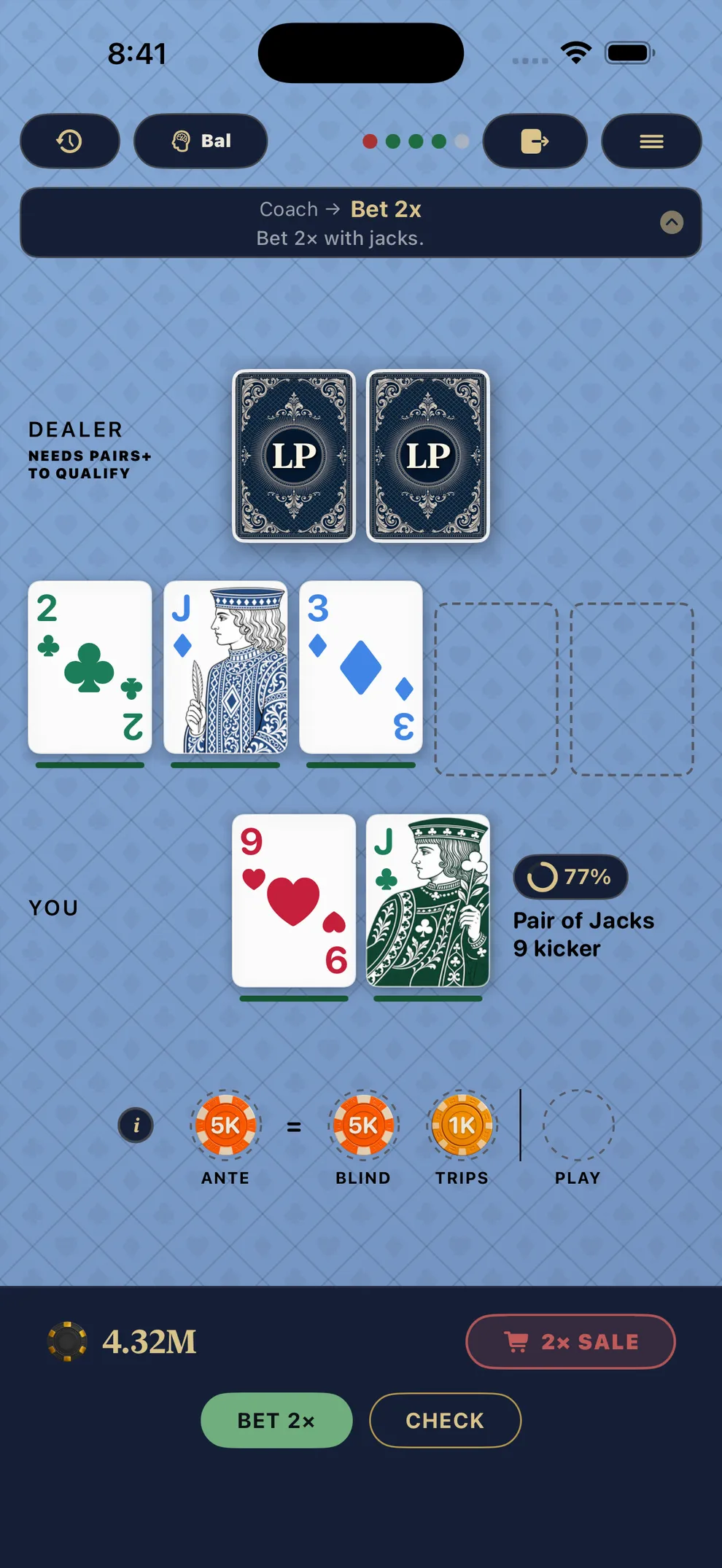
If you checked preflop, you now see three community cards and get a second chance to bet, this time 2× your Ante. Under every profile, two pair or better that uses at least one of your hole cards is a 2× bet. After that, the profiles differ.
In these rules, your pair means a pair that uses one of your own cards: a pocket pair, or a hole card that matches a board card. A pair that exists only on the board belongs to the dealer too, so it doesn't count.
- BasicBet 2× with two pair or better, any pair of yours (including pocket 2s and bottom pair), four cards to a flush, or four cards in a row from 2-3-4-5 up to 10-J-Q-K. Gutshots and the one-ended A-2-3-4 and J-Q-K-A don't count.
- BalancedBet 2× with two pair or better, or a pair of yours of 4s or higher. Smaller pairs check. No draws.
- DisciplinedBet 2× with two pair or better, or a pair of yours of 6s or higher. Also bet when the board itself is paired (6s or higher) and your highest card is at least a queen and outranks every unpaired board card. No draws.
Everything else checks and waits for the river.
Where Basic is looser than the published chart
The widely published flop rule bets two pair or better, a hidden pair except pocket 2s, and four to a flush only when you hold a ten or higher of that suit. Basic in Hold'em Coach goes further: it bets pocket 2s, bets any four-flush without the "hidden ten" test, and bets four-card straight draws. That's part of why it's the widest profile. If you want your flop play to match the published chart exactly, keep those three differences in mind.
05Turn and river: Bet 1× or fold
If you checked twice, all five community cards are out and you have one last choice: bet 1× your Ante or fold. Folding gives up your Ante and Blind, so the question is when a small bet is still worth it.
Bet with a hand that's really yours
Each profile first looks for a made hand that uses your cards:
- BasicBet 1× with any pair of yours that still plays, any hand that beats what the board makes on its own using your card, or an ace kicker when the only pair is on the board.
- BalancedBet 1× with any pair of yours that still plays, or a better hand than the board's using your card, or the board's hand with an ace kicker.
- DisciplinedSame idea, but one pair, two pair or trips must be built on a pair of 6s or higher. Small pocket pairs (2s to 5s) still bet if they beat the board and the board isn't all overcards.
"Still plays" means the board hasn't counterfeited it: if the board's own cards make a better hand that leaves your pair out of the best five, your pair no longer counts.
Otherwise, count dealer outs
By the river you can see seven cards, which leaves 45 unseen. A dealer out is an unseen card that, as one of the dealer's hole cards, would give the dealer a hand that strictly beats yours. Cards that would only tie you aren't counted, and neither are hands the dealer would need both hole cards to make. The outs fall into four groups: cards that complete or beat a flush, cards that complete or beat a straight, cards that pair the board, and overcards that out-kick you.
Fewer outs means your hand holds up more often. Each profile has a line, and the coach bets 1× when the outs are at or below it:
| Profile | Normal line | Below-board line |
|---|---|---|
| Basic | 21 | 18 |
| Balanced | 19 | 17 |
| Disciplined | 17 | 15 |
The below-board line applies when your hole cards don't play, meaning your best five cards are simply the board. The widely published strategy uses a single line of "fewer than 21 outs." Basic bets at exactly 21, uses the tighter 18 when you're below the board, and adds the two special cases below.
Disciplined has two more folds of its own: it folds when the board is paired, your cards don't play and your high card is a queen or lower ("Weak kicker"), and it never bets a high-card hand on outs alone, so ace-high without a pair is a fold under Disciplined whatever the count.
Scary boards: fold
If you've reached the outs count without a made hand of your own, and the board itself shows four cards to a flush, or four cards to a straight that a single dealer card would complete, the coach folds under every profile instead of counting. One card of that suit, or the card that fills the straight, is enough for the dealer, and those boards are where thin calls lose most.
Board chops: bet for the push
There's one place where betting with nothing makes sense. If your cards don't play and the board itself is strong (a straight or better, two pair or better, a pair of aces, or a pair with few enough outs), the dealer will often play the board too. Betting 1× then usually ends in a push of the main bets instead of losing your Ante and Blind to a fold. The coach calls this "Play the board — bet 1× for push," and it overrides the scary-board fold.
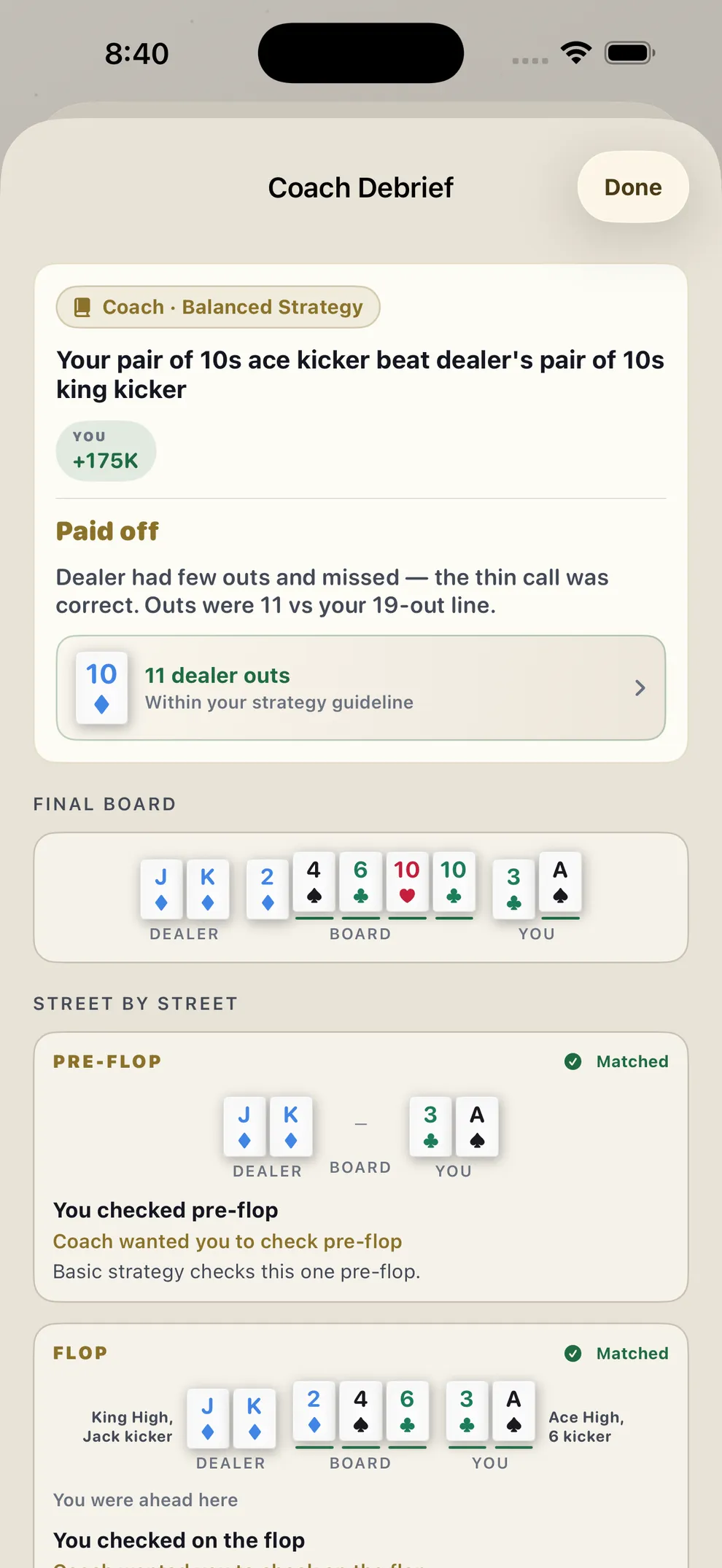
The Coach Academy's Dealer outs lesson uses exactly this kind of spot: you hold 2-3 offsuit, the board pairs eights, your cards don't play, and about 11 cards beat you, so the coach bets 1× for the push.
06Side bets
The Blind isn't optional: it's always placed and always equal to your Ante. The only true side bet is Trips, which pays on your own final hand from three of a kind up (see the pay table above), independent of the dealer. It pays even if you fold, and in Hold'em Coach it can't be larger than your Ante.
Hold'em Coach's coach doesn't advise whether to place Trips, under any profile. Placing it never changes the coach's recommendation either; at most the river note reminds you that "trips still pays" when you fold. Treat Trips as a separate decision from the Play-bet strategy in this guide: nothing on these pages depends on whether you place it.
07Common mistakes
- Betting 3× as a compromise. If the hand raises, raise 4×.
- Checking weak aces under Basic. A-2 offsuit looks thin, but every ace is a 4× raise in the Basic chart.
- Raising pretty suited cards. 9-8 suited and lower check under every profile. Under Basic, T-9 and T-8 suited are the lowest non-pair raises.
- Forgetting the offsuit kicker rule. K-4, Q-7 and J-9 offsuit all check under Basic.
- Betting 2× on a board pair. If the pair is only on the board, the dealer has it too.
- Mixing profiles. Balanced never bets flop draws; Basic does. Pick one chart and learn it before switching.
- Folding a pair of yours on the river. Under Basic and Balanced, any pair that uses your card and still plays is a 1× bet.
- Calling into four-flush boards. When the board shows four of a suit and you don't hold that suit, fold unless the board chop applies.
- Guessing instead of counting. Without a made hand, the outs line decides. Count before you fold.
08A seven-day practice plan
Reading a chart is step one. Making the right call without thinking takes repetition with feedback. Here's a week-long plan using the free features of Hold'em Coach; 15 to 20 minutes a day is enough.
| Day | Focus | What to do |
|---|---|---|
| 1 | Rules | Open Coach Academy and finish the six Basics lessons: Welcome, Hand rankings, Ante, Blind & Play, Trips side bet, Dealer must qualify, and Payouts & bonuses. |
| 2 | Preflop | Play the Academy's "Your first hand" and "Basic, Balanced & Disciplined" lessons. Then learn the Basic thresholds above and run the drill until you get 20 in a row. |
| 3 | Coach on | Play 50 hands at Lucky Palms with the coach on and the Basic profile. Decide before you read the coach's banner, then check yourself. |
| 4 | Debrief | Play another session and open the Coach Debrief after every hand where you disagreed with the coach. Focus on flop spots. |
| 5 | River | Do the Academy's "Win odds meter" and "Dealer outs" lessons, turn on Show dealer outs, and count before every river decision. |
| 6 | Review | Open Coach Report → Insights. Check your Coach Alignment (how often you followed the coach and how it went when you didn't) and your Deviation Hotspot. |
| 7 | Switch | Change to Balanced or Disciplined in Settings → Gameplay → Coaching profile and play a session. Notice which hands change answer. Filter Coach Report by profile to compare. |
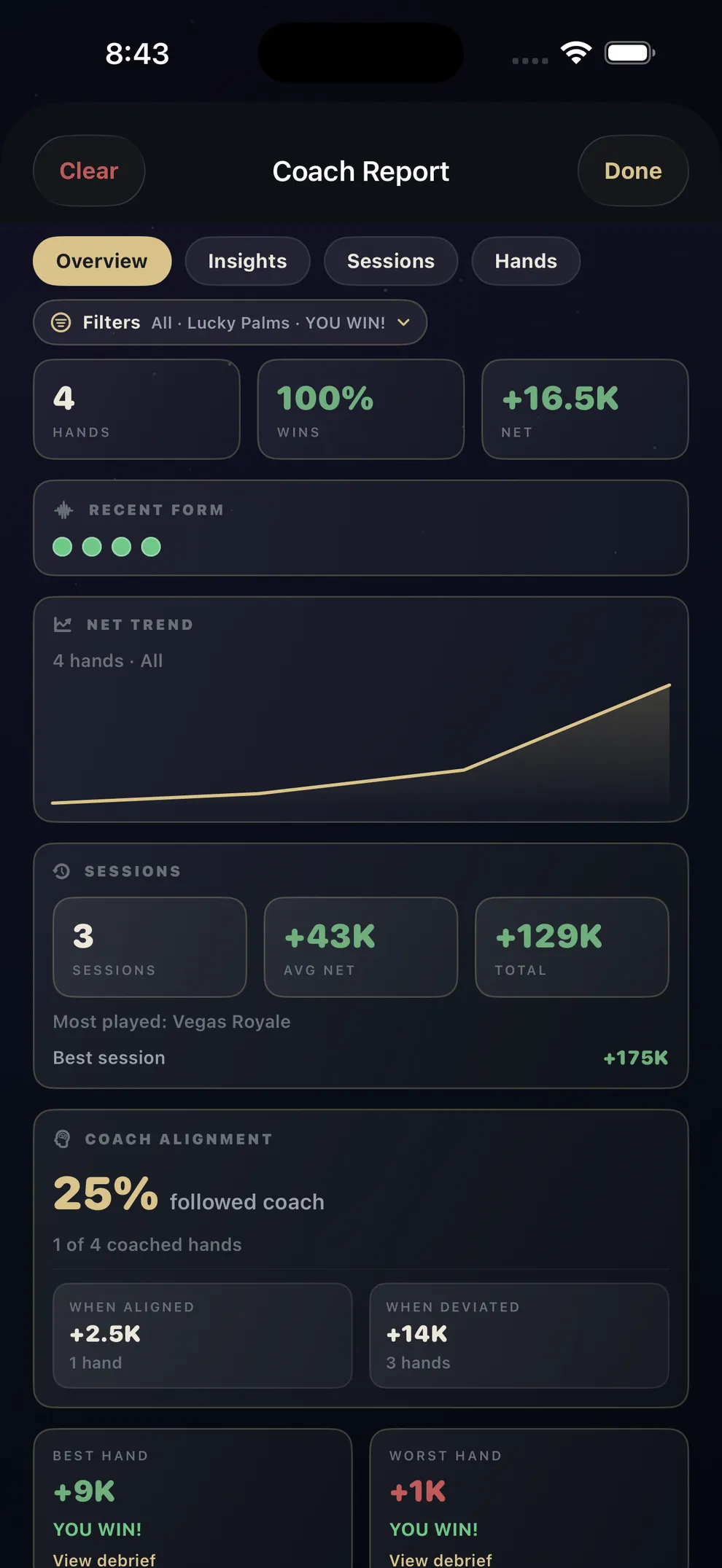
After a week most players know the preflop answer before the coach says it, which frees your attention for the harder flop and river spots. After 50 completed hands the app also lets you turn the coach off to test yourself (uncoached hands don't count toward Daily Stars or alignment). If you're starting from zero, how to learn Ultimate Texas Hold'em covers the first sessions in more detail.
09Frequently asked questions
What is the basic strategy for Ultimate Texas Hold'em?
Raise 4x preflop with any pair from 3-3 up, any ace, any suited king, an offsuit king with a 5 or better, a suited queen with a 6 or better, an offsuit queen with an 8 or better, a suited jack with an 8 or better, or jack-ten offsuit. If you check, bet 2x on the flop with two pair or better, a pair that uses your own card (the published chart excludes pocket 2s), or a four-card flush draw (it also wants a ten or higher of that suit in your hand). On the river, bet 1x with a hidden pair or better, or when few enough dealer cards beat you: fewer than 21 in the widely published strategy, 21 or fewer under Hold'em Coach's Basic profile. Otherwise fold.
Should you ever bet 3x preflop in Ultimate Texas Hold'em?
No. 3x is allowed, but if a hand is worth raising preflop it is worth raising the maximum 4x. The widely published basic strategy never uses 3x, and the coach in Hold'em Coach only recommends Bet 4x or Check before the flop.
Is there a 2x bet before the flop?
No. Before the flop the Play bet is 3x or 4x your Ante. The 2x bet is only available on the flop, and only if you checked preflop.
What happens when the dealer doesn't qualify?
The dealer needs a pair or better. If the dealer doesn't qualify, your Ante pushes (it is returned), but your Play and Blind bets are still settled against the dealer's hand: Play pays 1:1 if you win, and the Blind pays only with a straight or better.
What are dealer outs?
On the river, dealer outs are the unseen cards that, as one of the dealer's hole cards, would give the dealer a hand that strictly beats yours. Hold'em Coach's Basic profile bets 1x at 21 outs or fewer, Balanced at 19 or fewer and Disciplined at 17 or fewer, with lower lines when your own cards don't play.
Which Hold'em Coach profile is the best?
Basic is the default and the closest to the widely published basic strategy, so it's the one to learn first. Balanced and Disciplined are tighter, lower-variance training styles that raise fewer hands and fold more marginal river spots. They aren't more optimal; they trade some long-run value for smaller swings.
Should I bet Trips?
Trips is an optional side bet on your own final hand. It pays on three of a kind or better even if you fold, and can't be larger than your Ante. Hold'em Coach's coach doesn't advise on Trips either way; the decision is yours.
Can I practice Ultimate Texas Hold'em for free?
Yes. Hold'em Coach for iPhone and Android is free and uses virtual chips only, with a live coach on every decision, a 10-lesson Coach Academy and a debrief after every hand. No real-money gambling and no prizes of real-world value. 18+.
Sources and method
The game rules and pay tables are those implemented in Hold'em Coach 1.5.9. Every rule attributed to the Basic, Balanced and Disciplined profiles is taken from the app's coaching logic. Comparisons with the general strategy refer to the widely published Ultimate Texas Hold'em basic strategy at Wizard of Odds. Combination percentages are calculated from the charts on this page. Found an error? Email hello@suenainteractive.com.
Virtual chips only. No real-money gambling and no prizes of real-world value. 18+.